Most morning routines ask too much. They want an hour. They want cold plunges and gratitude journals and a smoothie with twelve ingredients. They want you to become someone else before 7 a.m.
This is not that.
This is five minutes. A glass of warm water. A few slow breaths. A quiet moment before the world asks anything of you. It comes from a tradition that the World Health Organization recognizes as one of the most enduring medical systems on earth -- one that has studied mornings for thousands of years, not to optimize them, but to honor them.
Why mornings matter in TCM
Traditional Chinese Medicine sees the body as a landscape. It has rivers, weather, seasons. And like any landscape, it has a rhythm.
In TCM, the hours between 5 and 7 a.m. correspond to the Large Intestine meridian -- a time the body naturally wants to release and renew. The hours from 7 to 9 a.m. belong to the Stomach meridian, when your digestive fire is waking up. A simple morning ritual works with this internal clock, not against it.
You do not need to memorize meridian charts. The key idea is this: your body already knows how to begin a day. A morning ritual just means getting out of its way.
Think of it like opening the curtains in a room. The light was always there. You are just letting it in.
The ritual: five steps, five minutes
No equipment. No app required (though Terrain can guide you through each step if you want the company). Just you and a few minutes of stillness.
Step 1: Warm water first
Before coffee. Before your phone. Before anything.
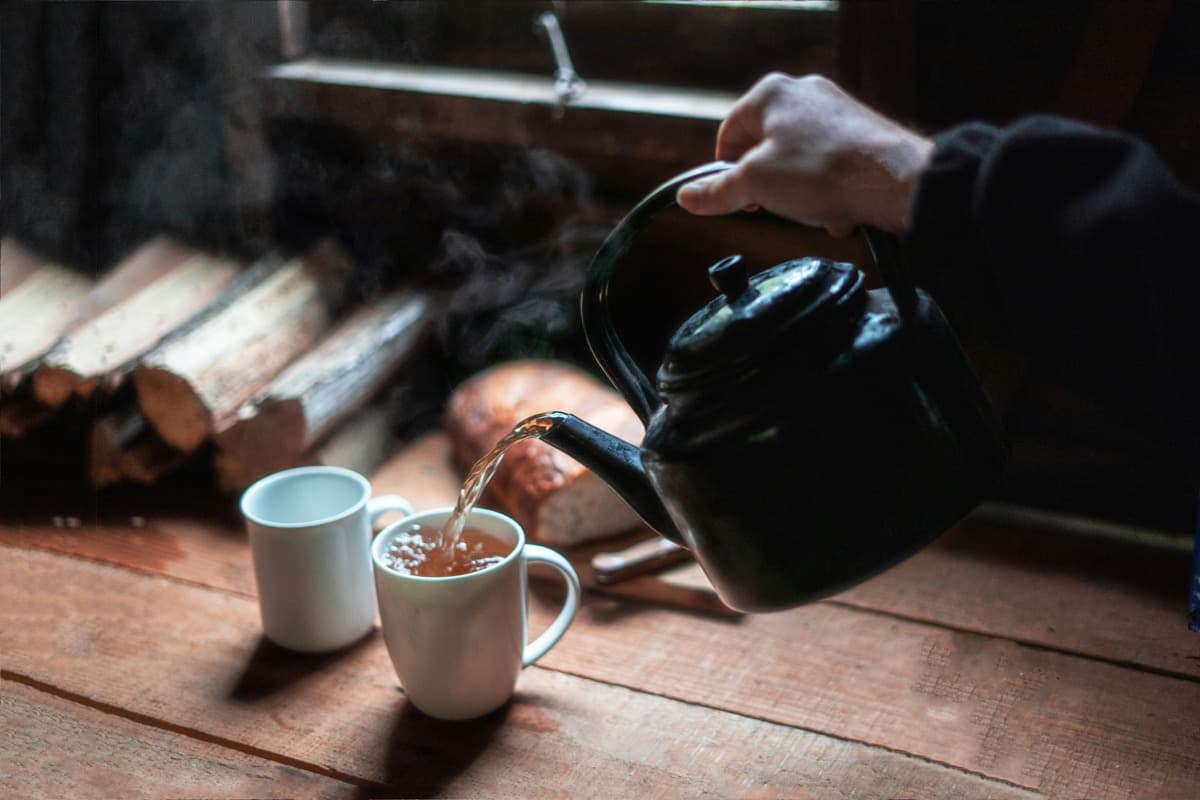
Boil water and let it cool just enough to drink comfortably. Not hot enough to burn, not lukewarm. Pleasantly warm -- the temperature of a calm bath.
Drink it slowly. One full glass.
qi flows best when the body is warm and hydrated. After a full night of sleep, your system is dry. Cold water first thing can shock a sluggish digestive system -- imagine pouring ice water on a campfire that is just starting to catch. Warm water does the opposite. It gently stokes the fire.
This matters for every terrain profile, but especially for 🕯️ Low Flame types, who tend to run cold and slow in the mornings. If that sounds like you -- if you are the person who takes forty-five minutes to feel awake, who wraps both hands around a mug like it is the only warm thing in the world -- warm water is your simplest, most foundational act of self-care.
If plain warm water feels too bare, add a thin slice of fresh ginger. Ginger is warming by nature and helps activate your spleen qi -- the part of your system that turns food into fuel. One slice is enough. This is not a recipe. It is a nudge.
Step 2: Three conscious breaths
Still standing in the kitchen. Still holding your water, maybe. Just pause.
Breathe in through your nose for a count of four. Let the air fill your belly, not just your chest. Breathe out through your mouth for a count of six. The exhale is longer than the inhale. That ratio matters.
Do this three times. That is all.
A longer exhale activates your parasympathetic nervous system -- the rest-and-digest mode. Research reviewed by the NCCIH confirms that slow, diaphragmatic breathing practices -- central to both qigong and TCM daily cultivation -- measurably reduce stress markers and improve autonomic balance. In TCM terms, you are settling your shen, which tends to scatter during sleep and needs a moment to collect itself upon waking.
You may notice your shoulders drop on the second breath. That is your body saying thank you.
🌀 Busy Mind types often carry tension from the moment they open their eyes. The jaw is tight. The shoulders are already up near the ears. If mornings feel immediately heavy or irritable, these three breaths are especially important. They are not about relaxation as a luxury. They are about giving your body permission to circulate before you start demanding things of it.
Step 3: A 30-second body scan
You do not need to sit on a cushion. You do not need to close your eyes (though you can).
Start at the top of your head. Move your attention slowly down through your body -- forehead, jaw, neck, shoulders, chest, belly, hips, legs, feet. You are not trying to fix anything. You are just noticing. Where is there tension. Where is there ease. Where do you feel nothing at all.
This takes thirty seconds. Maybe less.
If you find a spot that feels tight, let your next exhale go there. Imagine the breath softening that area, the way warm water softens dried tea leaves. You do not need to stretch yet. Just notice.
In TCM, awareness precedes change. Practitioners feel the pulse before making any recommendation. Your body scan is the same principle -- you are taking your own pulse, learning your own landscape. Over time, this daily check-in becomes a quiet conversation between you and your body. You start to notice patterns. Tuesdays are tight in the shoulders. Cold mornings settle in the lower back. This knowledge is the beginning of understanding your terrain.
If your body wants to stretch after the scan, let it. Roll the neck gently. Twist the torso. Reach the arms overhead. Follow what feels natural. Thirty seconds of intuitive movement is worth more than ten minutes of a routine your body did not ask for.
Step 4: Add an ingredient (optional)
This step is for the days you want a little more. It is never required.
Each terrain profile responds to different ingredients. Here are three gentle options for your morning water:
For 🕯️ Low Flame profiles: A thin slice of fresh ginger or two dried jujube dates in your warm water. Both are warming. Jujube is mildly sweet and nourishes the blood -- think of it as a gentle hug for your digestive system on days when even breakfast feels like too much to consider.
For 🌀 Busy Mind profiles: A few thin slices of lemon or a sprig of fresh mint. Both help move liver qi, which is the energy most associated with feelings of stagnation and frustration. If you wake up feeling stuck before the day has even started, citrus in warm water is a small, bright intervention.
For 🪫 Low Battery profiles: A teaspoon of honey stirred into your warm water. Honey is moistening and nourishing -- a gentle way to replenish fluids for systems that tend to run dry. If you wake up with a dry throat, dry skin, or a restless feeling that you cannot quite name, honey in warm water is remarkably settling.
You do not need to know your terrain profile to start. Plain warm water is the universal beginning. If you are curious about which profile resonates with you, Terrain's quiz can help you find your starting point.
❄️ Winter guidance
In winter, consider making your water slightly warmer than usual and favoring ginger or jujube regardless of your profile. The cold months ask more of your body's warming energy. Even Low Battery types, who normally benefit from cooling and moistening ingredients, can welcome a little ginger in January. Listen to the season as well as your constitution.
Step 5: Set an intention
Not a to-do list item. Not a productivity goal. A quality.
Patience. Softness. Clarity. Courage. Ease. Curiosity.
Choose one word that describes how you want to move through the day. Not what you want to accomplish -- how you want to feel while you are doing it.
Hold it in your mind for a moment, the way you might hold a warm stone in your palm. Then set it down and begin your day.
This is not manifestation. It is orientation. You are pointing your attention in a direction before the emails and notifications start pointing it for you.
The whole ritual at a glance
- Warm water -- one glass, before anything else
- Three breaths -- in for four, out for six
- Body scan -- thirty seconds, top to bottom
- An ingredient -- optional, based on how you feel
- An intention -- one word, one quality
Total time: three to five minutes.
Starting smaller than you think
Here is the part where most guides say "commit to doing this every day." We are not going to say that.
Do it tomorrow morning. Just once. See how it feels. If you forget a step, that is fine. If you only manage the warm water and one breath before your toddler starts yelling, that is a morning ritual. It counts.
Three minutes is enough. Two minutes is enough. The warm water alone, if that is all you do, is enough.
TCM is a tradition that has endured for thousands of years not because it demands perfection, but because it meets people where they are. As the NCCIH notes, TCM's emphasis on individualized, pattern-based care is what distinguishes it from one-size-fits-all approaches. It understands that change happens slowly. That the body responds to consistency more than intensity. That a small thing done with attention is more powerful than a large thing done with resistance.
Your morning ritual is not a performance. It is a quiet agreement between you and your body: I am here. I am paying attention. We are starting together.
That is enough. That has always been enough.
Curious which terrain type you are?
The Terrain app opens with a short terrain quiz. Join the waitlist to be first in line.
Join the WaitlistTo learn more about the body types mentioned in this ritual, see The 8 Terrain Types: Which One Are You?. For warming ingredients to add to your morning water, see 5 Warming Ingredients for Cold Winter Days.